
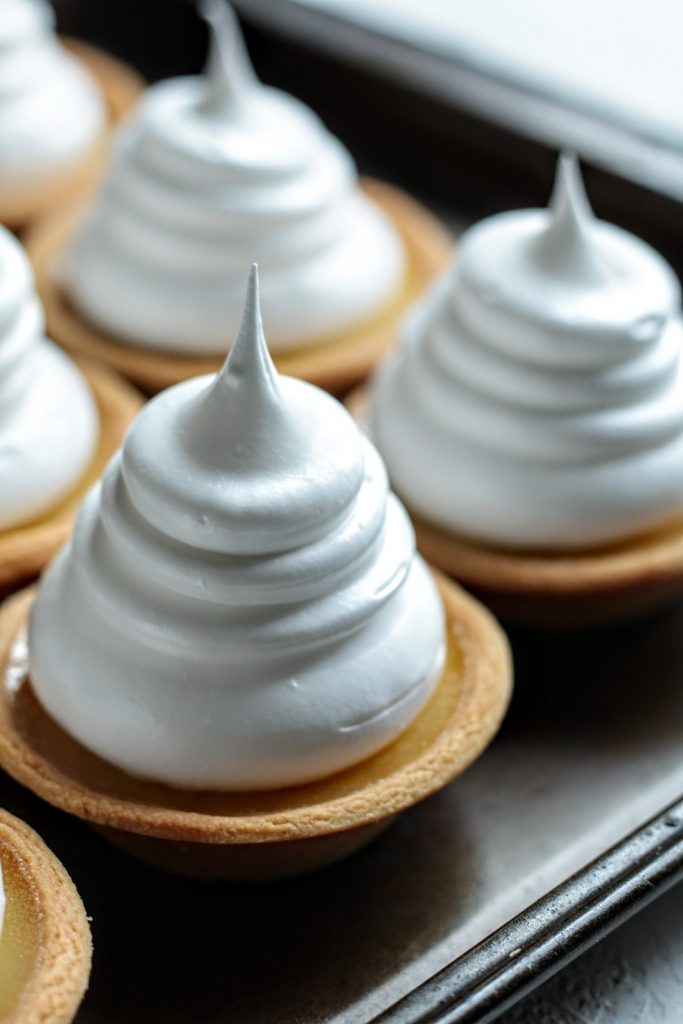
### Ingredients
– 2 egg whites (blancs d’œufs) — approximately 60–70 g total, at room temperature
– 220 g granulated sugar (sucre en poudre)
– 8 cl (80 ml / 80 g) water (eau)
– Optional / mentioned in context: a pinch of cream of tartar or lemon juice (for stability, though not explicitly listed here; common in pro recipes)
(Note: This is a smaller batch suited for mini desserts or garnishes in the book’s style. Standard scaling is double the egg white weight in sugar, with water to dissolve it.)
### Instructions
**Step 1** — In a small saucepan, combine the sugar and water. Bring to a boil over medium-high heat without stirring (to avoid crystallization). Use a candy thermometer to monitor the temperature. Cook the syrup until it reaches 118–120 °C (around the “soft ball” or “boulé” stage). The syrup will be clear and bubbling vigorously.
**Step 2** — While the syrup is cooking (start when it approaches ~100–110 °C), place the egg whites in a clean, grease-free bowl (ideally a stand mixer with whisk attachment). Begin whipping them at medium-high speed until they become frothy and start to increase in volume. Do not whip them to stiff peaks yet — they should be soft and mousse-like.
**Step 3** — When the sugar syrup reaches 118–120 °C, remove it from the heat immediately (it may continue to rise slightly to ~121 °C from residual heat). With the mixer running at medium-high to high speed, slowly pour the hot syrup in a thin, steady stream down the side of the bowl (avoid pouring directly onto the whisk to prevent splashing or graininess). Continue whipping.
**Step 4** — Keep whipping at high speed until the mixture is fully cooled, glossy, stiff, and voluminous (it should form firm peaks and feel cool to the touch, about 8–10 minutes). The meringue will be very stable and shiny. If adding flavor (e.g., citrus zest for lemon/orange tartlets as hinted in the book), incorporate it now gently.
Use this meringue to garnish tartlets, cupcakes, or small pastries (e.g., pipe it on and torch for a brûlée effect, or bake briefly if the recipe calls for it). It’s perfect for buttercreams (crèmes au beurre) or when you need a meringue that holds up well without weeping. Avoid over-whipping once cooled, as it can become grainy.
This Italian meringue is safer and more stable than French or Swiss versions because the egg whites are partially cooked by the hot syrup. Use immediately for best results (it holds shape well but can deflate slightly if stored too long).
Leave a Reply